Made by Dermalogica
Daily Microfoliant
Rice Powder Exfoliant
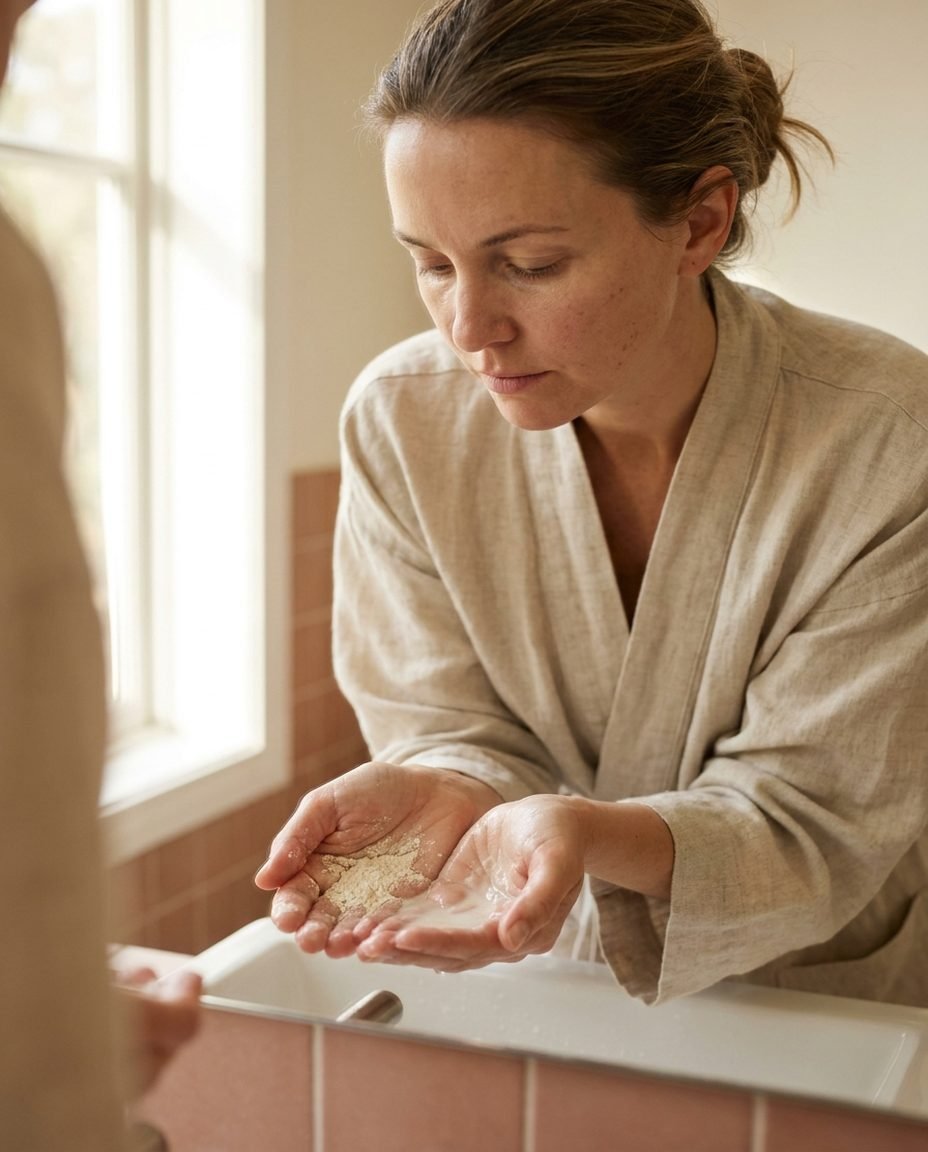
A dry rice-based powder that turns into a creamy paste the moment it meets water in your hands. Ultra-fine rice powder, papaya enzyme and salicylic acid work together to lift dull surface cells — gently enough that it is made for daily use, not for the once-a-week scrub that leaves your face stinging.
- Ultra-fine rice powder base
- Papain, a papaya enzyme
- Salicylic acid (BHA)
- Rice bran in the formula
- Gentle enough for daily use
- Dry, oily and combination skin
Current price, size options and availability are shown on the Amazon listing.
For external use on the face only.
The exfoliation trap
Harder is not the same as better.
Most people reach for the grittiest scrub on the shelf, use it once a week, feel the friction, and read that feeling as proof it worked. The feeling is not the result. What actually decides the outcome is how evenly you exfoliate and how consistently you do it — neither of which improves when you press harder.
Friction is not a dosage
With a coarse scrub, the intensity is set by how hard you happen to rub that morning. Two people using the same tube are not doing the same thing, and neither are you on two different days.
Your skin sheds every day, not once a week
Shedding surface cells is a continuous process that depends on enzymes and on there being enough water present. A single hard session followed by six days of nothing does not match that rhythm.
Dull is a surface problem first
Light reflects cleanly off a smooth surface and scatters on a rough one. Before you buy another serum, it is worth asking whether the layer sitting on top is what is dimming it.
Three mechanisms, one step
Powder, not grit. Three kinds of exfoliation at once.
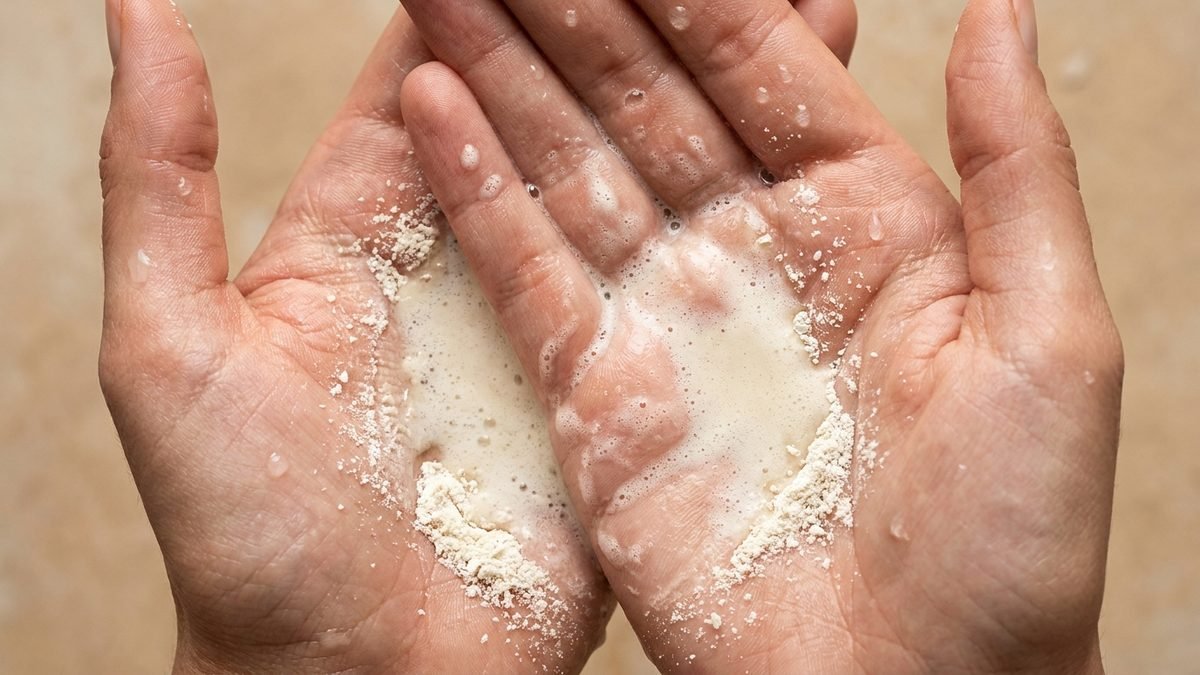
The product ships dry. Water is what activates it, and that happens in your hands, seconds before it touches your face. Three different kinds of exfoliation are working at once, and none of them depends on you pressing harder.
- Rice powder, physically. A uniform ultra-fine particle that buffs the surface evenly, rather than a jagged grain that catches on it.
- Papain, enzymatically. An enzyme from papaya that helps loosen the protein bonds holding dead surface cells in place, so they release instead of being scraped off.
- Salicylic acid, into the pore. A beta hydroxy acid that is oil-soluble, which is why it is the acid associated with congested pores rather than surface texture alone.
- Rice bran, alongside. Included in the formula with the rice powder base that gives the product its name.
Why particle size matters
The same amount of exfoliation can leave two very different surfaces.
This is a simplified illustration of a geometric idea, not a photograph of skin. Larger, irregular particles concentrate contact at a few points. Smaller, uniform ones spread the same contact across many. That is a difference in evenness, and evenness is what a reflective surface is made of.
Coarse, irregular grain
Particles of uneven size and shape. Contact concentrates at a few points, so the surface is worked at inconsistent depths.
Ultra-fine, uniform powder
Particles of a similar, much smaller size spread the contact out. The surface is buffed level instead of being cut into at random points.
Diagram is conceptual and drawn for explanation only. It is not microscopy, not to scale, and not a depiction of a clinical result. To be clear about what is and is not established: we are illustrating a geometric argument about particle size and contact, not claiming that coarse scrubs have been shown to damage the skin barrier. Where chemical and mechanical exfoliation have been compared head to head in a controlled trial, the two performed comparably — see the research section below.
Thirty seconds, once a day
The whole method is: wet hands, paste, rinse.
These are the manufacturer’s directions, in plain words. The one detail people get wrong is the water — hands need to be very wet, or the powder never becomes a paste.
Dispense into very wet hands
A small amount is enough — roughly half a teaspoon. Your palms should already be wet before the powder lands in them.
Rub into a creamy paste
Bring your hands together and work the powder until it stops looking like powder and becomes a soft, creamy lather.
Massage onto the face, then rinse
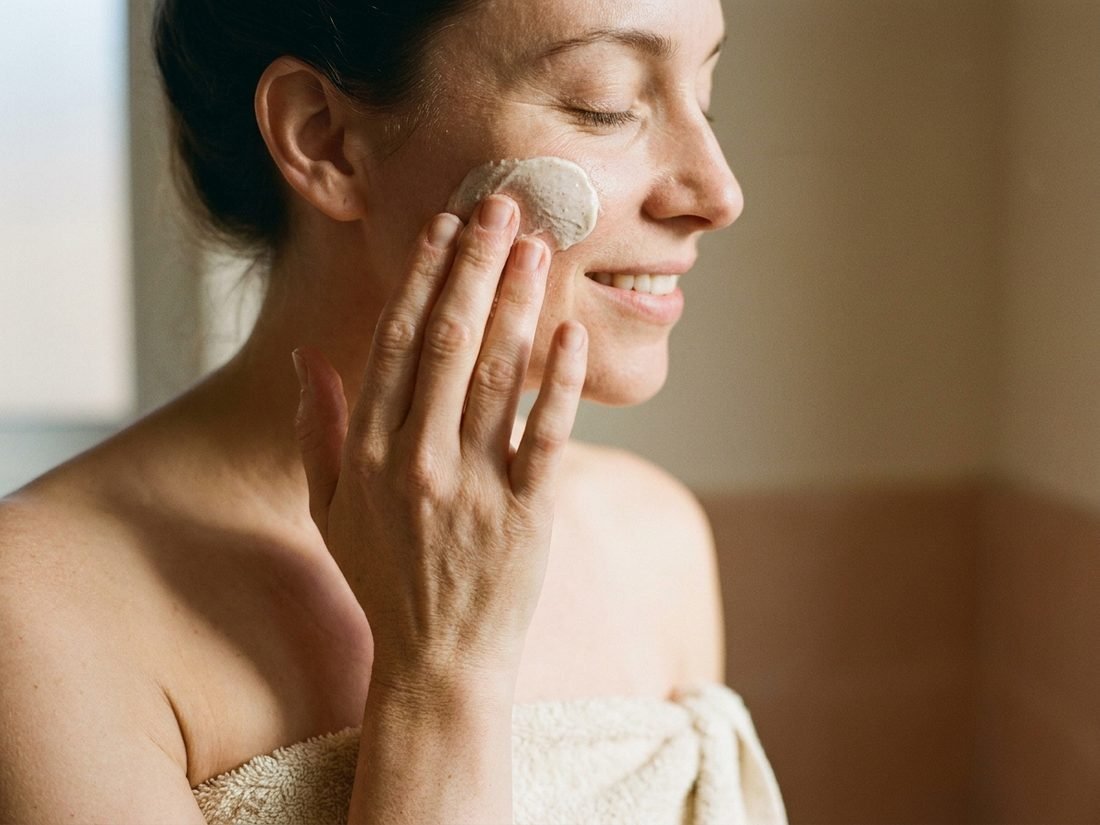
Light circular pressure across the face, then rinse thoroughly. No scrubbing, no pressing — the formula does the work, not your hands.
The mistake almost everyone makes
Dry hands. That is it. If the powder does not have enough water to work with, it never becomes a paste, and you end up rubbing dry grains across your face and concluding the product does nothing.
The manufacturer positions this as suitable for daily use. If your skin is reactive, or you are already using retinoids or other acids, start every other day and see how your skin responds before going daily. Wear sunscreen — exfoliating acids and sun exposure are a poor combination.
The other Korean habit people ask us about
Korea has a skin tradition you rinse with, and one you eat with a spoon.
The one you eat is gelatin. Ask about Korean skin for long enough and someone will move the conversation to the table — the broth simmered until it sets, the trotters served cold, the collagen jelly stick from the convenience store. It is a real tradition and it is worth understanding properly, because there is decent research sitting next to it, that research is not quite about the thing people think it is about, and the whole story stops at a specific depth in your skin. That stopping point is why this section is on a page about an exfoliant.
The tradition is a stockpot, not a supplement
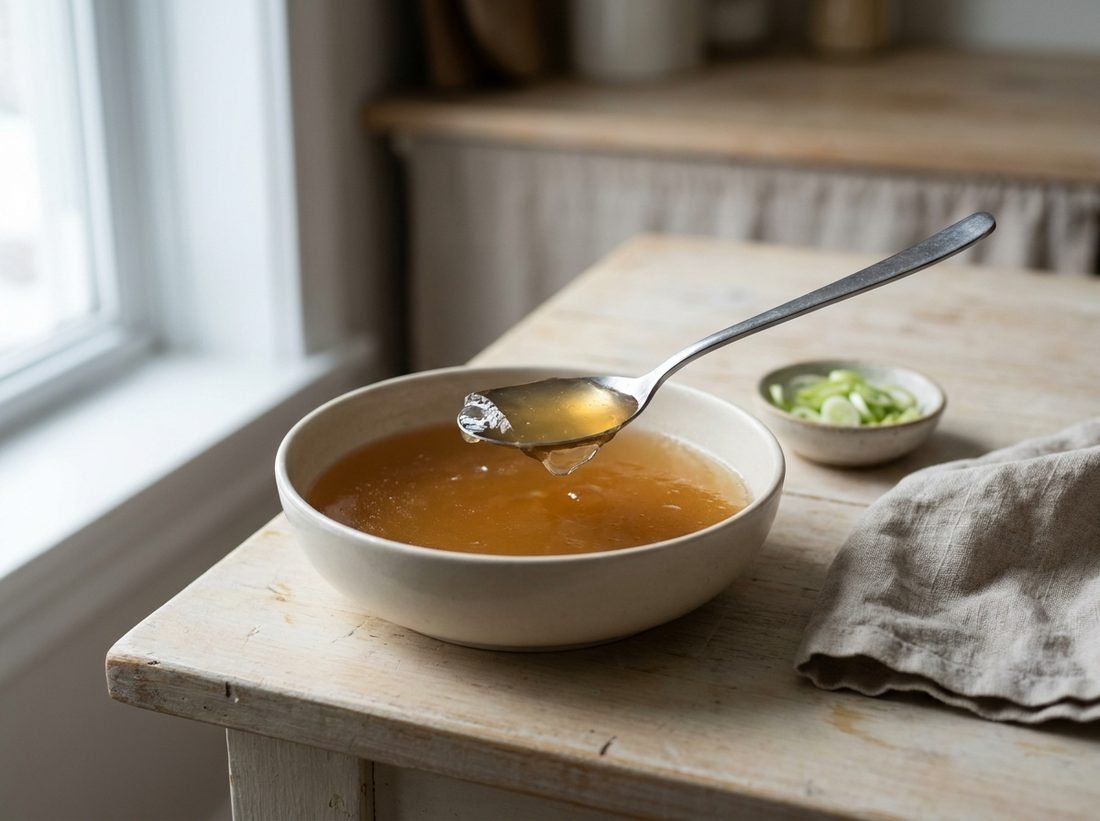
Sagol-guk and seolleongtang are ox bone broths simmered for hours, until the connective tissue in the bones gives way. Chill a bowl overnight and it sets by itself. That wobble is gelatin, which is nothing more exotic than collagen that has been cooked apart. Jokbal — braised pig trotters, sliced and eaten cold — is the same material eaten straight, and it carries a long-standing reputation in Korea as food you eat for your skin.
The modern descendant sits in every convenience store: collagen jelly sticks and drinkable ampoules, a whole aisle of them. Those are not the stockpot. They are a processed ingredient carrying a weighed dose on the label — and as it turns out, that difference is the entire argument.
! The wobbling Korean jelly in most photographs is not collagen at all
Search for Korean jelly and what you will mostly be shown is muk — dotori-muk set from acorn starch, cheongpo-muk from mung bean. They are real dishes, they are excellent, and they contain no animal collagen whatsoever, because they are set with starch rather than with gelatin. Two completely different foods wobble in exactly the same way. If someone is selling you a Korean jelly cube on the strength of a photograph, the photograph is not evidence of what is in it.
What the trials actually used
Three conditions, and a bowl of soup meets none of them.
It was hydrolysed first
Every trial we could verify used hydrolysed collagen peptides — collagen already cut by enzymes into short fragments before it ever reaches you. Broth and kitchen gelatin sit a step behind that, and nobody has run the trial on the bowl.
It was a weighed dose
The controlled trials we read used roughly 2.5 to 5 grams a day, every day, measured out. A helping of jokbal or a bowl of sagol-guk is a meal rather than a dose, and how much gelatin is in it changes with the pot.
It ran for weeks
Eight weeks in the two 2013 trials, twelve in the 2019 one, and the 2021 meta-analysis lands on ninety days of continuous intake before it will call the effect real. Nothing in this story happens in a week.
✓ What the evidence does support
- The pooled result is real. A 2023 meta-analysis of 26 randomised controlled trials covering 1,721 people found hydrolysed collagen significantly improved skin hydration and elasticity against placebo.
- It is not simply digested into nothing. A 2005 paper identified food-derived collagen peptides in human blood after volunteers drank gelatin hydrolysates, so the quick dismissal that none of it survives the stomach is too quick.
- The wrinkle finding was measured, not eyeballed. In a 2013 trial of 114 women aged 45 to 65, eye wrinkle volume fell about 20 per cent against placebo over eight weeks, by instrument rather than by opinion.
× What it does not do, and what the papers admit
- It does not exfoliate anything. Nothing you swallow lifts dead cells off the surface of your face. Collagen lives in the dermis, underneath the layer an exfoliant is working on.
- One key trial cannot isolate the collagen. The 2019 study that improved hydration, elasticity, roughness and density used a drink containing collagen peptides plus acerola extract, vitamin C, zinc, biotin and a vitamin E complex. A blend that works does not tell you which part worked.
- The supportive papers flag their own weakness. The 2023 meta-analysis states it identified several biases in the trials it pooled and calls for larger ones. The 2013 elasticity trial found its skin moisture and water-loss results failed to reach significance, and reported that too.
A controlled trial of gelatin as food
We went looking for a study that took bone broth, plain kitchen gelatin or a homemade jelly, gave it to people and measured skin outcomes against a control group. We did not find one. Everything we could verify tests a pre-hydrolysed peptide powder at a weighed daily dose, and one of those trials names a specific commercial ingredient. That does not make the Korean tradition wrong, and it does not make the food less good. It means the research people quote in its defence was collected on something else, and the honest sentence is that the bowl itself has never been tested.
So here is where the two things actually sit, and it is a question of depth rather than of which one wins. Collagen — if it does what the pooled trials suggest — works in the dermis, the living layer underneath, over eight to twelve weeks, and only in a form your stockpot does not produce. This product works on the stratum corneum, the layer of already-dead cells sitting on top, this morning, in about thirty seconds. Neither one reaches the other one’s layer, so neither one replaces the other.
Which is also why you will not find a collagen claim anywhere else on this page. There is no collagen in this product and there is not supposed to be — it is rice powder, papain and salicylic acid, working on the surface. Anyone selling you an exfoliant on a collagen story is describing a layer it never gets near.
Eat the jokbal because it is good. Just do not expect it to do the polishing, and do not let anyone charge you for a jelly cube on the strength of a wobble. The six papers behind this section are in the research list below, and nothing here is medical or nutritional advice — see the disclaimer in the footer.
Where the rice part comes from
Long before rice was in an exfoliant, it was a bowl of cloudy water.
In Korean kitchens, the water left over from rinsing rice has its own name — ssal-tteumul (홙똜물) — and it does not go down the drain. It goes into stews and soups, and it has a long folk history of going onto skin instead. If you want to understand why rice ended up in a powder on a bathroom shelf, that bowl is where it starts.
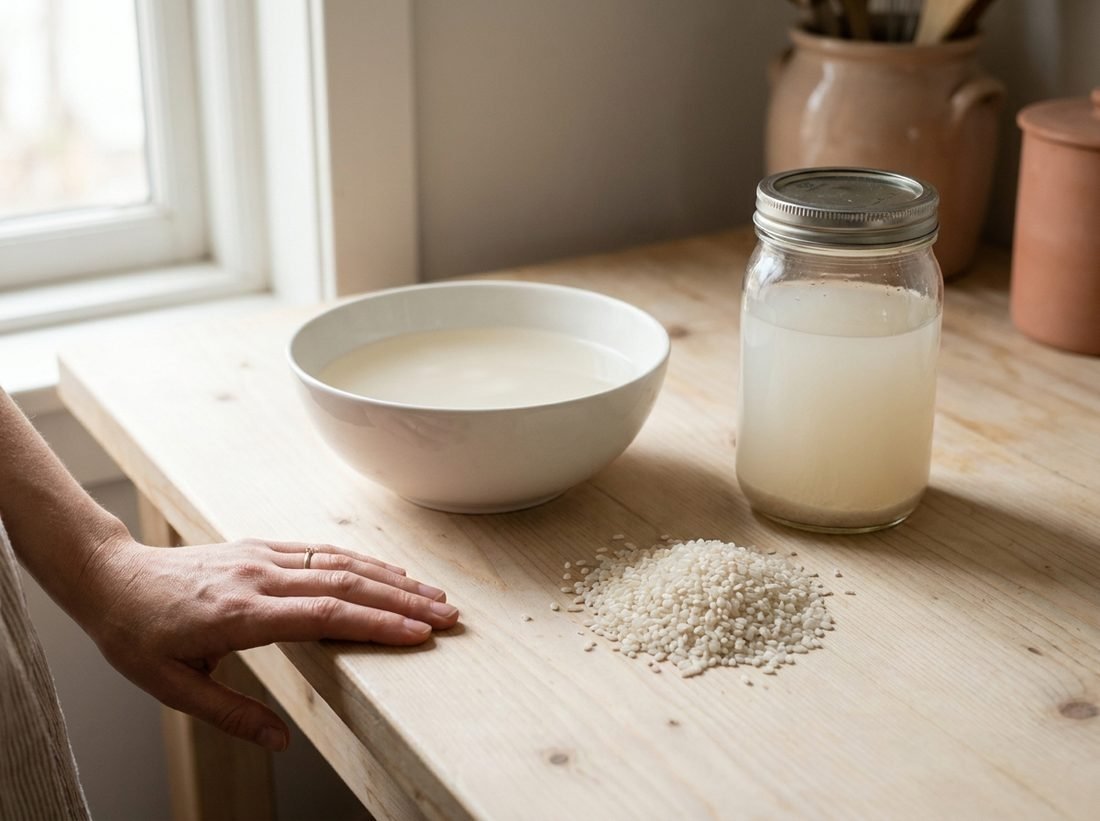
It is starch, bran and whatever comes off the grain
Rinse water is cloudy because it is carrying something: loose starch, very fine fragments of bran, and the water-soluble compounds that wash off the outside of the grain. Leave a jar of it on the counter and you can watch the starch drop out and settle into a pale layer at the bottom.
That is the same raw material this product is built on — rice powder and rice bran — arriving by a completely different route. The tradition suspends it in water in your hands. The powder arrives dry and you add the water yourself.
The recipe, in full
You can make it tonight and it costs nothing.
Throw the first rinse away
Cover about half a cup of uncooked white rice with water, swirl it briefly and pour that first water off. It carries the dust and whatever the grain picked up in storage.
Keep the second one
Add roughly a cup of clean water to the same rice and swirl it for about thirty seconds, until the water turns properly milky. That cloudy water is the ssal-tteumul. Strain the rice out.
Let it settle, then use it cold
Rest it twenty to thirty minutes so the heaviest starch sinks. Use it as a rinse or on a cotton pad after cleansing, keep it in the fridge, and make a new batch the next day.
! The fermented version is where the actual risk is
A lot of guides tell you to leave the water out for a day or two first, so it sours. That does change the chemistry — but an unpreserved liquid left at room temperature is also growing whatever happens to be in your kitchen, and you are then putting it on your face. If you try the rinse, we would keep it fresh, keep it refrigerated, and not stretch a batch past a day. Anything you leave to ferment on a counter is not a controlled preparation, and it should not go near broken or irritated skin.
A primary source for the “Joseon palace” origin story
Almost every page selling rice water will tell you that court ladies of the Joseon dynasty washed with it, and some name a specific practice. We went looking for a historical source behind that and came back with brand blogs citing other brand blogs. What is easy to verify is the ordinary part: ssal-tteumul is a real, current Korean household practice with a real name, used in cooking and on skin. The palace story we are filing as folklore until someone shows us the document.
✓ What the rinse plausibly does
- Adds a little water and a little starch. A hydrogel made with 96% rice water tested as skin-compatible over 28 days in a small panel, and rice water showed antioxidant and elastase-inhibiting activity in the dish.
- Is very unlikely to sting. The dermatology review of rice-derived ingredients describes them as safe, non-irritating and hypoallergenic, which matches how people actually report using it.
- Costs nothing to try. You already bought the rice. If you like it, that is a real result and no one needs to sell you anything.
× What it does not do
- It does not exfoliate. A rinse is a rinse. There is no enzyme dose and no acid in it, and the starch is suspended, not working on anything.
- It is not standardised. Your batch and ours are different liquids. The 2025 review of rice fermentation products spends its closing section on exactly this — standardisation and efficacy measurement are the open problems in the whole category.
- It does not have much behind it yet. The human data here is small panels and reviews, not large controlled trials. Treat it as a pleasant tradition with early support, not as a treatment.
So the honest version of the connection is this: the Microfoliant is not bottled ssal-tteumul, and anyone implying that is selling you a story. What it borrows is the format — fine rice particles suspended in water, in your hands, against your skin. What it adds is the part a rinse cannot do: papain and salicylic acid at a controlled dose, in a dry powder that cannot spoil on your counter.
Try the rinse if the tradition appeals to you — it is free and it is pleasant. Just do not expect it to do the exfoliating, because that is not where the exfoliation in this product comes from. The three papers behind this section are in the research list below.
How the categories differ
Powder exfoliant, gritty scrub, or an at-home acid peel.
This compares three approaches to exfoliation, not three brands. Which one suits you depends on your skin and how often you actually want to do this.
| Rice powder exfoliant | Gritty physical scrub | At-home acid peel | |
|---|---|---|---|
| How it exfoliates | Fine particles, enzyme and BHA together | Friction from coarse particles | Acid concentration and contact time |
| Typical frequency | Designed for daily use | Usually once or twice a week | Weekly or less |
| Control over intensity | High — you set the amount and the water | Low — pressure varies every time | Fixed by the formulation |
| Common complaint | Needs enough water to activate | Stinging, redness, uneven results | Downtime, peeling, sun sensitivity |
| Shipped as | Dry powder, activated in your hands | Pre-mixed cream or gel | Liquid, pads or masks |
General characteristics of each category, offered to help you choose an approach. Individual products within every category vary widely.
Straight answer
This is not for everyone. Here’s the honest split.
✓ A good fit if you…
- Have dull, uneven texture and want a daily step rather than a weekly event
- Have found gritty scrubs too harsh but still want physical smoothing
- Have oily or combination skin and congested pores
- Travel often and want a dry format that will not leak
- Prefer to control the dose yourself rather than pump a fixed amount
! Not for you if you…
- Have active, inflamed acne, eczema, rosacea or broken skin — talk to a dermatologist first
- Are already using prescription retinoids or strong acids without professional guidance
- Are pregnant or breastfeeding and have been advised to avoid salicylic acid
- Have a known allergy to salicylates, papaya or rice-derived ingredients
- Want an overnight change — surface texture takes consistent weeks, not days
Rooted in research
What the literature actually says about these ingredients.
We would rather show you peer-reviewed work than a wall of star ratings. These papers are about the ingredients and the mechanisms in general — none of them studied this product, none of them is evidence of any specific result for you, and we have included the ones that complicate the story as well as the ones that support it. Read them yourself.
Salicylic acid as a peeling agent: a comprehensive review
Explains that salicylic acid works by loosening the junctions holding dead surface cells to one another, rather than by dissolving the keratin inside them, and that being oil-soluble is what lets it travel into pores. Note that this review covers professional peel-strength concentrations, not the low percentages used in a daily cosmetic product.
doi:10.2147/CCID.S84765Dry skin, moisturization and corneodesmolysis
Describes how healthy skin sheds its surface cells in an orderly, invisible way — a process that needs enzymes to cut the protein rivets between cells, and enough water present for those enzymes to work. When that breakdown is impaired, cells stay stuck together and accumulate, which is what produces visible flaking.
doi:10.1046/j.1467-2494.2000.00001.xAn overview of the use of proteolytic enzymes as exfoliating agents
A review finding that protein-digesting enzymes including papain can mimic the skin’s own shedding by breaking down the proteins that hold dead cells in place, and that formulation pH and enzyme stability strongly affect whether they still work. The authors located only 11 relevant articles and very few clinical trials, and conclude more rigorous human studies are needed — so treat enzymatic exfoliation as plausible rather than established.
doi:10.1111/jocd.14673Glycolic Acid Peels Compared to Microdermabrasion: A Right-Left Controlled Trial
Ten people had a chemical peel on one side of the face and mechanical microdermabrasion on the other, once a week for six weeks. Seven of ten preferred the chemical side, but that fell short of statistical significance and neither investigator ratings nor photographs found a measurable difference between the methods — a useful corrective to anyone claiming one approach is decisively superior.
doi:10.1046/j.1524-4725.2002.01144.xAnti-aging efficacy of topical formulations containing rice bran bioactive compounds
Rice bran extract rich in ferulic acid and gamma-oryzanol was encapsulated in lipid carriers and tested on 30 volunteers for 28 days with instrument-based measurements, showing improvements in hydration, roughness and elasticity versus comparison formulas. The effect is tied to that specific encapsulated delivery system, not to rice bran in any form.
doi:10.3109/13880209.2011.596206Rice Water: A Traditional Ingredient with Anti-Aging Efficacy
The authors open by stating plainly that no scientific evidence supported rice water’s role in skincare products, then set out to test it. Rice water showed antioxidant activity and an elastase-inhibiting effect in vitro, and a gel made of 96% rice water was found skin-compatible and cosmetically suitable on a panel of twelve volunteers over 28 days. Twelve people is a very small panel and the in-vitro findings are not the same as a clinical outcome — this is a first look, not a settled result.
doi:10.3390/cosmetics5020026Dermatological uses of rice products: Trend or true?
A review of what has been published on rice, rice bran and fermented rice bran in skincare. It identifies the individual components involved, reports antiaging, anti-inflammatory, photoprotective and moisturising properties, and concludes rice-derived ingredients are safe, non-irritating and hypoallergenic. Worth knowing how it was assembled: the authors searched PubMed and Google, which makes this a narrative overview rather than a systematic appraisal of evidence quality.
doi:10.1111/jocd.15099Biologically Active Components and Skincare Benefits of Rice Fermentation Products
A review of what fermentation does to rice — it raises the level of organic acids, amino acids, polyphenols and polysaccharides — and of the moisturising, antioxidant and anti-inflammatory effects reported for the resulting products. The part we found most useful is the ending, where the authors set out the open problems in their own field: standardisation, component analysis and how efficacy is evaluated. That is the honest state of play for anything rice-fermented, homemade very much included.
doi:10.3390/cosmetics12010029Oral Supplementation of Specific Collagen Peptides Has Beneficial Effects on Human Skin Physiology
Sixty-nine women aged 35 to 55 took 2.5 g or 5.0 g of collagen hydrolysate or placebo daily for eight weeks. Skin elasticity, the primary interest, improved significantly against placebo in both dose groups. Worth reading to the end: the skin moisture and water-loss results moved in a positive direction but failed to reach statistical significance, which the authors report rather than bury.
doi:10.1159/000351376Oral Intake of Specific Bioactive Collagen Peptides Reduces Skin Wrinkles and Increases Dermal Matrix Synthesis
A hundred and fourteen women aged 45 to 65 took 2.5 g of a bioactive collagen peptide or placebo daily for eight weeks. Eye wrinkle volume fell around 20 per cent against placebo by instrument measurement, and suction blister biopsies found more procollagen type I and elastin in the treated group. Note that the peptide tested is a named commercial ingredient, not gelatin in general.
doi:10.1159/000355523Effects of hydrolyzed collagen supplementation on skin aging: a systematic review and meta-analysis
Nineteen randomised, double-blind, controlled trials totalling 1,125 participants aged 20 to 70, of whom 95 per cent were women. Pooled, hydrolysed collagen beat placebo on hydration, elasticity and wrinkles, and the authors settle on ninety days of intake as the point where the effect shows. Every trial in it used hydrolysed collagen — none of them used food.
doi:10.1111/ijd.15518Effects of Oral Collagen for Skin Anti-Aging: A Systematic Review and Meta-Analysis
The largest pool we found: 26 randomised controlled trials and 1,721 patients, with significant improvements in skin hydration and elasticity versus placebo. It is also the paper that argues against itself most usefully — it states plainly that it identified several biases in the trials it included, and that further large-scale randomised trials are needed to confirm the finding.
doi:10.3390/nu15092080A Collagen Supplement Improves Skin Hydration, Elasticity, Roughness, and Density
Seventy-two women aged 35 and over took a drinkable supplement or placebo for twelve weeks, with hydration, elasticity, roughness and density measured by instrument, and all four improved significantly. The catch is in the formula: the drink carried 2.5 g of collagen peptides plus acerola extract, vitamin C, zinc, biotin and a vitamin E complex, so the trial cannot tell you the collagen is what did it.
doi:10.3390/nu11102494Identification of Food-Derived Collagen Peptides in Human Blood after Oral Ingestion of Gelatin Hydrolysates
The bioavailability question, answered directly: after volunteers ingested gelatin hydrolysates, collagen-derived peptides were identified in their blood. This is why the flat dismissal that collagen is simply digested into nothing is not accurate. It is also only a bioavailability paper — it measures what reaches the bloodstream, not what happens to anyone’s face.
doi:10.1021/jf050206pNo verifiable evidence that abrasive scrubs damage the skin barrier
We went looking for it, because it is the claim this category loves to make. We could not find a peer-reviewed study that establishes it, and the one head-to-head trial we did verify found mechanical and chemical exfoliation performed comparably. So we are not making that claim. The case for a fine powder here is about even contact and daily consistency, not about rescuing you from damage.
These studies are independent scientific literature on exfoliation and on the ingredients used in this category. They were not conducted on this product, are not endorsements of it, and do not establish that any particular outcome will occur for you. Two of the rice bran papers rely on a specific encapsulation technology that is not necessarily present in any given retail formula. The three rice water papers are about rice water and rice fermentation products, which is the tradition this ingredient comes from — they are not studies of this product, and none of them tested a rinse you make at home. The six collagen papers are there for the gelatin section and are about an oral supplement, not about this product or about any topical: every one of them tested hydrolysed collagen peptides at a weighed daily dose, two of them a specific commercial preparation, and none of them tested a food.
Questions people actually ask
Before you buy
Can I really use it every single day?
The manufacturer positions it as gentle enough for daily use, and many people do use it daily. That said, “can” is not “must”. If your skin is reactive, or you are already on retinoids or other acids, start two or three times a week and build up only if your skin stays calm. Nobody’s face is obliged to follow the label.
Will it sting or make me peel?
It is formulated as a gentle daily exfoliant rather than a peel, so it is not designed to produce visible flaking or downtime. Salicylic acid can still cause tingling, dryness or irritation in some people, especially at first or when layered with other actives. If it stings persistently, stop and reduce the frequency.
Why powder instead of a normal scrub in a tube?
Two practical reasons. You control the dose, so the same tub works for a light day and a thorough one. And because it is dry until you add water, you decide how thick the paste is — which is your intensity dial. The trade-off is that it needs genuinely wet hands, and people who skip that step end up rubbing dry powder on their face and concluding it does nothing.
How long does one container last?
Longer than people expect, because the correct dose is small — roughly half a teaspoon. That is the single most repeated point in the customer reviews on the Amazon listing: a little goes a long way. Both a travel size and a full size are offered, so if you are unsure, the smaller one is a low-commitment way to find out whether the format suits you.
Does it work on body skin too?
It is sold and labelled as a face product, and that is how it is meant to be used. Some people use exfoliants elsewhere, but this page is not going to tell you to use a product outside its labelled purpose. Follow the manufacturer’s directions on the listing.
Is it worth the price?
It is a premium-priced exfoliant, and the reviews split honestly on this — some call it worth it because the container lasts months, others find the size too small for the money. We would rather point that out than pretend everyone agrees. Check the current price and the size options on Amazon and decide against what you already spend on this step.
Who am I actually buying from, and how do returns work?
The listing we link to is sold by Dermalogica US and shipped by Amazon, with Amazon’s free 30-day refund or replacement window. Total Balance does not sell, stock or ship anything. Price, stock, delivery, returns and refunds are all handled by Amazon and the seller of record on that listing.

One step, done properly
Stop sanding.
Start polishing.
Thirty seconds a day, a dose the size of half a teaspoon, and a surface that reflects light instead of swallowing it. Check the current price and size options on Amazon.
Buy Now →Sold by Dermalogica US · Shipped by Amazon · Free 30-day returns